
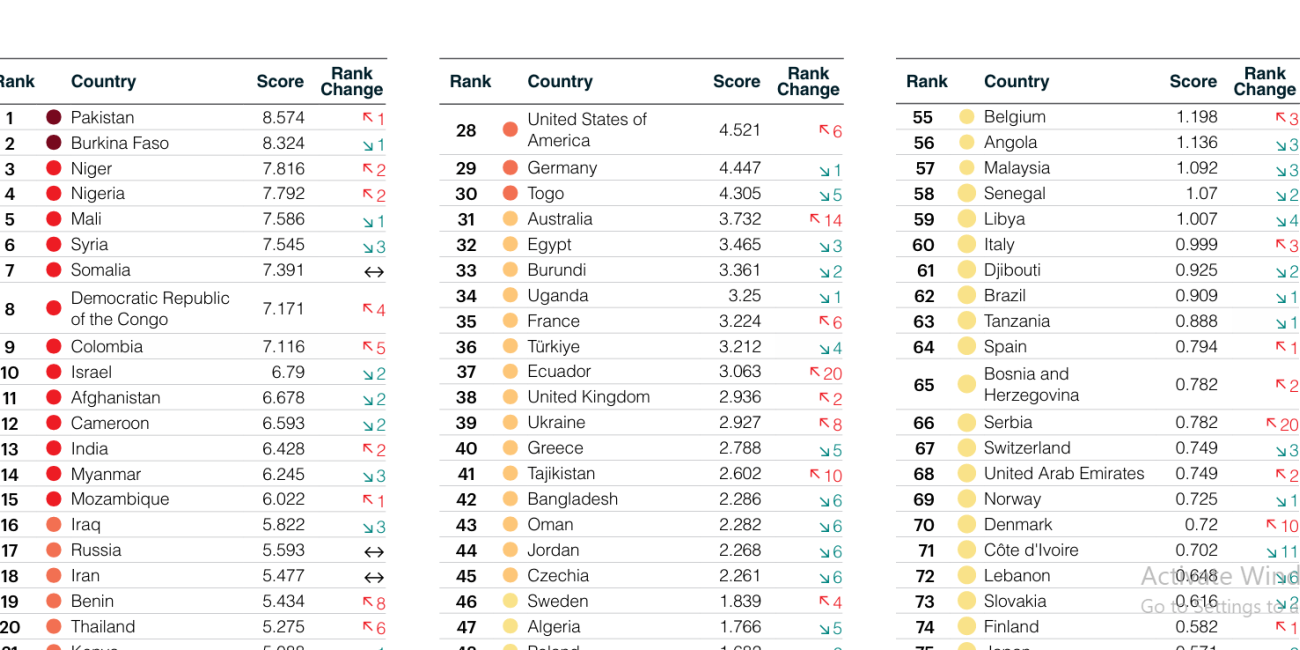
Nigeria Fourth In Global Terrorism Index, Reports Largest Death Toll Increase Amid Global Decline
Nigeria Records Sharp Rise in Terrorism Fatalities — Report
March 19, 2026 | News
Nigeria has recorded one of the most significant increases in terrorism-related deaths globally, despite an overall decline in fatalities worldwide, according to the 2026 Global Terrorism Index (GTI).
The report, published by the Institute for Economics & Peace, revealed that terrorism deaths in Nigeria rose by 46 per cent in 2025 to 750.
It attributed about 80 per cent of these fatalities to Islamic State West Africa Province (ISWAP) and Boko Haram.
Global Trends and Regional Impact
According to the GTI, terrorism remains highly concentrated, with nearly 70 per cent of global deaths occurring in just five countries: Pakistan, Burkina Faso, Nigeria, Niger, and the Democratic Republic of the Congo.
Nigeria and the Democratic Republic of the Congo recorded the highest increases in fatalities, with rises of 237 and 102 deaths respectively.
Sub-Saharan Africa continues to bear the greatest burden, with six of the 10 most affected countries located in the region—cementing its position as the global epicentre of terrorism.
Deadliest Attacks in Nigeria
The report noted that Nigeria accounted for two of the 20 most fatal terrorist attacks recorded globally in 2025, both occurring in Borno State.
One of the attacks took place on September 5, 2025, in Darajamal village, Bama Local Government Area, where gunmen killed 58 villagers and five soldiers. Although no group officially claimed responsibility, local reports attributed the assault to ISWAP.
In another incident on May 15, 2025, jihadists attacked the neighbouring villages of Mallam Karamti and Kwatandashi in Kukawa Local Government Area. About 100 civilians were reportedly abducted, with 57 bodies later recovered and dozens still missing. The attack was linked to a faction of Boko Haram.
Global Decline, Uneven Progress
Despite Nigeria’s spike, global terrorism trends showed improvement in 2025. Deaths from terrorism fell by 28 per cent to 5,582, while incidents dropped by 22 per cent to 2,944—the lowest levels since 2007.
However, the decline was uneven. Western countries recorded a sharp rise in terrorism-related deaths, which increased by 280 per cent to 57, driven largely by antisemitism, Islamophobia, and politically motivated attacks.
For the first time since the index began, Pakistan ranked as the country most impacted by terrorism, recording 1,139 deaths and 1,045 incidents—its highest level since 2013.
Emerging Concerns
The report also highlighted growing concerns over youth radicalisation, noting that investigations involving young people have tripled since 2021. In Western countries, 93 per cent of fatal attacks were carried out by lone actors.
Globally, Islamic State (IS) and its affiliates remained the deadliest group, responsible for nearly 17 per cent of all attacks in 2025. Other major contributors included Jamaat Nusrat Al-Islam wal Muslimeen (JNIM), Tehrik-e-Taliban Pakistan (TTP), and al-Shabaab.
In addition, the GTI observed a shift in attack patterns, with more than 76 per cent of incidents occurring within 100 kilometres of international borders—up significantly from 2007.
Outlook
While 81 countries recorded improvements—the highest since 2021—the report warned that rising geopolitical tensions, particularly in the Middle East, could reverse recent gains.
It stressed that the sharp increase in terrorism fatalities in Nigeria underscores the urgent need for stronger counter-terrorism strategies and sustained international cooperation to address the growing threat.